Wim van der Hoek’s Design Principles – Applying and Extending his Legacy
During the 2026 Precision Fair in Den Bosch (NL) on Thursday, November 19, 14:00-16:10 h, DSPE will host the “Wim van der Hoek’s Design Principles – Applying and Extending his Legacy” colloquium.
The event – free admission for Precision Fair visitors – will mark the 20th anniversary of the Wim van der Hoek Award. This award (also known as the Constructors Award) was introduced in 2006 to mark the 80th birthday of the Dutch doyen of design engineering principles, Wim van der Hoek (1924-2019). The Constructors Award is presented every year to the person with the best graduation project in the field of design in mechanical engineering at a Dutch or Belgian university of technology or university of applied sciences.
The colloquium will be led by chairperson Susan van den Berg (Fontys University of Applied Sciences and Berg Precision Publishing). Presentations will be given by Piet van Rens, Volkert van der Wijk and Ron de Bruijn, about ‘Designs and Mechanisms’ (based on Wim van der Hoek’s design principles lecture notes, a.k.a. Des Duivels Prentenboek, ‘The Devil’s Picture Book’).
Technology and student wellbeing
Piet van Rens, precision engineering veteran and recipient of the Lifetime Achievement Award from the American Society for Precision Engineering (ASPE), will share memories of his master/teacher and friend. “Wim van der Hoek was a master in his profession, involved in technology but even more involved with the wellbeing of his students. He inspired people to grow and develop themselves. In this lecture, I will show a few technical examples as a memory to him as a master/teacher and inspirator.”
Dynamically balanced mechanisms
Volkert van der Wijk, kinetic artist & former gentleman scientist at TU Delft, will talk about principles for the design of dynamically balanced (vibrationless) mechanisms for high-speed manipulators and kinetic sculptures. “When robot manipulators and mechanisms move at high speeds, significant vibrations are induced by the dynamic reaction forces and moments
on the base. It is possible to design manipulators dynamically balanced such that they do not induce vibrations and have zero dynamic reactions. Instead of trying to balance a certain robot, generally leading to unpractical solutions with a significant increase of mass, inertia and complexity, I will explain my method of inherent dynamic balancing where, on the contrary, dynamic balance forms the starting point in the design process. I will share examples from robotics and my kinetic sculptures.”
Outlook on the future of design principles
Ron de Bruijn (assistant professor of Design Principles for Precision Mechatronics at TU Eindhoven) will pose an intriguing question: Which principles come next? “Wim van der Hoek’s design principles have not only survived, they have shaped the shift from mechanisation to mechatronisation that characterises today’s advanced multidisciplinary high-tech systems. I will address current and future design principles in education and research, extending to industrial practice. Although modern systems are inherently multidisciplinary, the mechanical and mechatronic core remains decisive. Starting from that core, I will give an outlook on where precision mechanical and mechatronic design must develop further to keep advancing system performance in the broadest sense of the word.”
Note for the press (not for publication)
For further information please feel free to contact:
• Jos Gunsing, chairman Wim van der Hoek Award jury, +31 (0)6 – 519 94 190, jos.gunsing@dspe.nl.
• Julie van Stiphout, operations manager DSPE, +31 (0)6 – 543 08 703 info@dspe.nl.
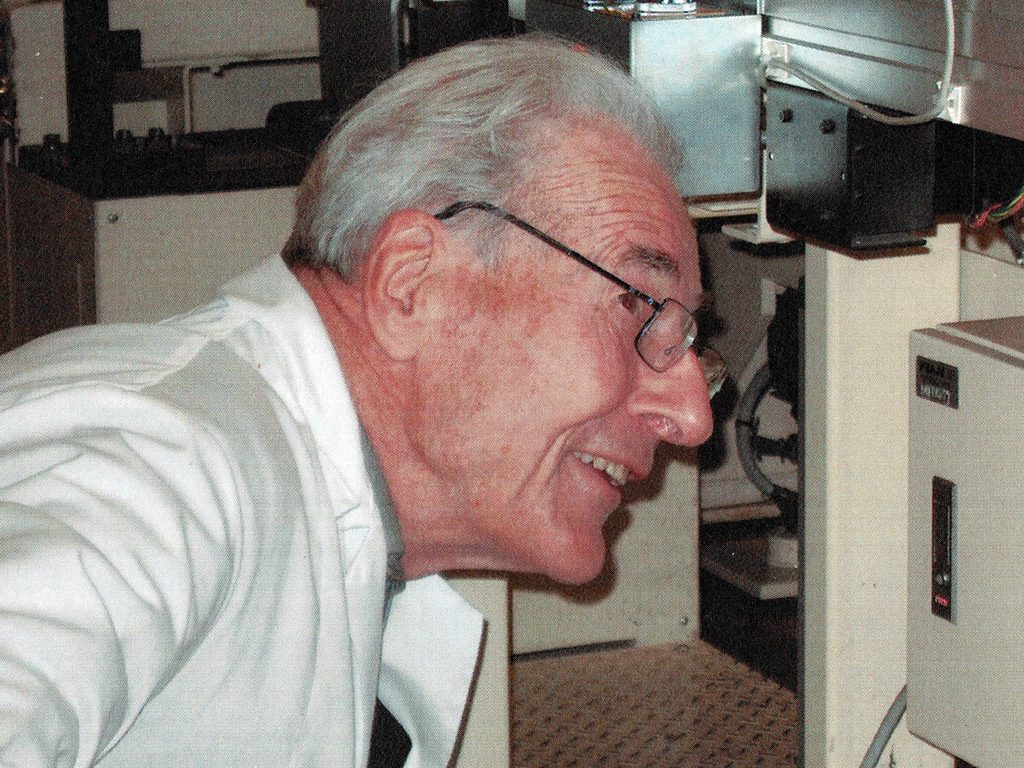
Attached please find a photo, with the following suggested caption:
Wim van der Hoek during a company visit of WIE (Werktuigkundig Ingenieurs Eindhoven, Mechanical Engineers Eindhoven) to Alcatel Bell Telephone in Geel (B), spring 2004.