Problem 2: Fixed-guided-in-Y beam
The equations for all 3 thermal load cases are shown below, the colors represent temperature field (white is high and black is low). The equations give the axial deformation u of the beam, the deflection w of the beam, and the axial stresses in the beam.
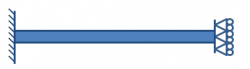 | Boundary Conditions: u (x=0) = 0 w (x=0) = 0 β (x=0) = 0 u (x=L) = 0 β (x=L) = 0 D (x=L) = 0 |
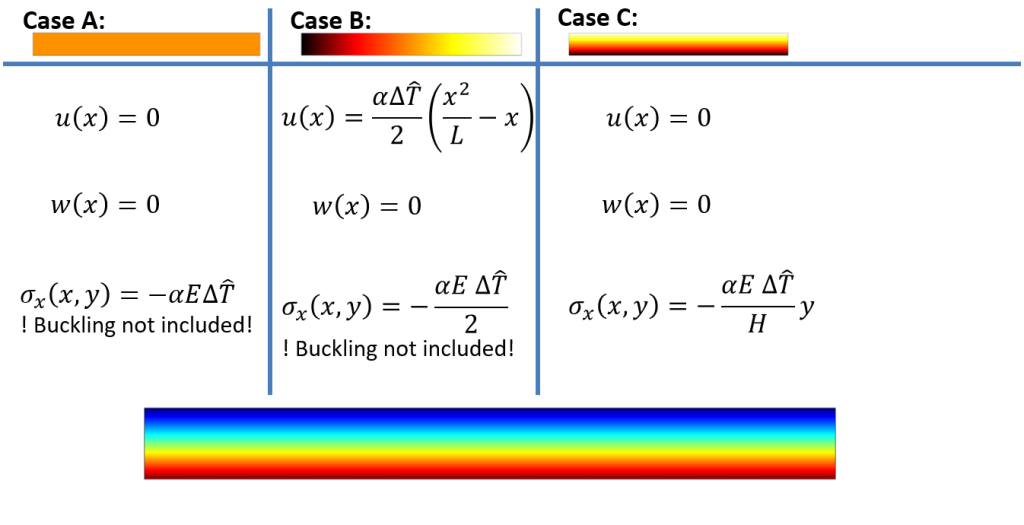
The figure of the deformed beam illustrates the deflection resulting from load case C. Colors represent the axial stress field (green is zero, red is positive and blue is negative). Note that the boundary effects as shown in the figure is not included in the equations!
| Name | Symbol | Units | Description |
| Shear force | D | N | Internal shear force as function of the longitudinal direction (x) |
| Young’s modulus | E | N/m2 | Young’s modulus of the material |
| Axial force | F | N | Internal axial force as function of the longitudinal direction (x) |
| Height | H | m | The total length of the beam |
| Length | L | m | The total length of the beam in longitudinal direction |
| Moment | M | N/m | Internal moment as function of the longitudinal direction (x) |
| Temperature | ΔT | K | The biggest temperature difference in the beam |
| Axial deformation | u | m | Axial deformation of the beam as function of the longitudinal direction (x) |
| Deflection | w | m | Deflection of the beam as function of the longitudinal direction (x) |
| CTE | α | K-1 | Coefficient of thermal expansion (CTE) of the material |
| Rotation | β | rad | Rotation of the beam as function of the longitudinal direction (x) |
| Axial stress | σx | m | Axial stress of the beam, i.e. combined thermal and mechanical stress, as function of the longitudinal direction and the direction perpendicular (x and y) |
References ...

Learn how AI in Engineering develops at ASML, Sioux and TU/e
Read more
During the 2026 Precision Fair in Den Bosch (NL) on Thursday, November 19, 14:00-16:10h, DSPE will host the “Wim van der Hoek’s Design Principles – Applying and Extending his Legacy” colloquium.
Read more
The seventh edition of the DSPE Opto-Mechatronics Symposium will take place on 8 October 2026. This year’s theme is ‘The opto-mechatronics of telescopes: from tiny to extremely large’.
Read more