EVENT 4 October 2021
Lunch Lecture November hosted by NTS-group
Experimental validation of forced flow cooling Speaker; Bart Koolmees System Lead Engineer at NTS-group As in most projects when hardware is realized, test are performed to validate the design. In...
About this event
Experimental validation of forced flow cooling
Speaker; Bart Koolmees System Lead Engineer at NTS-group
As in most projects when hardware is realized, test are performed to validate the design. In this case, verification of forced air cooling is conducted. Initial verification of the CFD analysis was limited to measurements of air flow and input power to the fan. A difference of 4.6x was found between analysis and actual measurement, which is not satisfactory. This induced multiple iterations, both in the CFD-analysis and in the experiment, which resulted in an error reduction down to 20%. Critical effects that were initially overlooked are; a swirl in the air-flow and, the pressure head of the fan. All lessons learned are taken into account while iterating on the heat sink design, enabling us to make it as small as possible. This presentation will explain the difference between CFD and measurements as well as the critical details required to predict the performance of forced air cooling with sufficient accuracy.
This work is conducted in close collaboration with:
- Feiyu Geng Multi-physics Modelling Specialist at NTS-group
- Nico Tan Technical Specialist at NTS-group
- Kees Verbaan System Architect at NTS-group
We will start at 12:02pm on November 1st.
Please send an email to info@dspe.nl if you are interested in this Lunch lecture.
The Netherlands
DigitalReferences ...
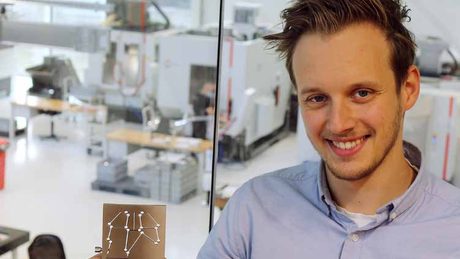
Wim van der Hoek Award celebrates 20th anniversary
The Wim van het Hoek award (also known as the Constructors Award) was introduced in 2006 to mark the 80th birthday of the Dutch doyen of design engineering principles, Wim van der Hoek (1924-2019).
Read more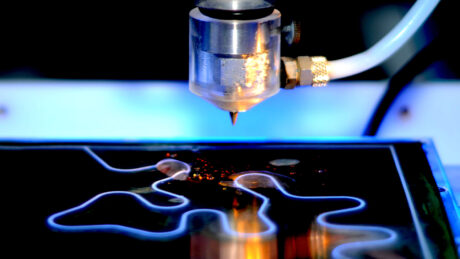
National Systems Engineering Event Calendar
A single overview of the major Systems Engineering events in the Netherlands
Read more
Knowledge day: “AI & (mechanical) Design”
Learn how AI in Engineering develops at ASML, Sioux and TU/e. On november 5th DSPE organizes a knowledge day to intend to inform the DSPE members about the (im-) possibilities of applying AI in mechanical- and system design
Read more