EVENT 1 December 2025
Lunch lecture hosted by ASMPT
Machine Learning-Based Feedforward Control Using ILC
About this event
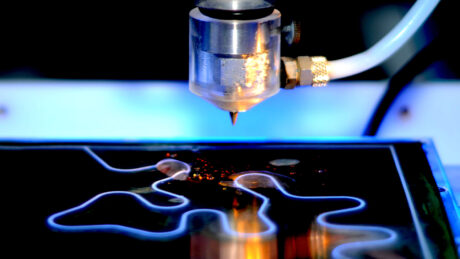
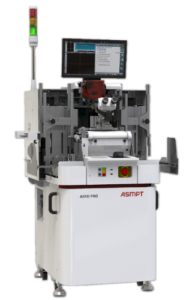
Current state-of-the-art feedforward controllers of the industrial high-tech machines are limited in performance due to hard-to-model dynamics, such as cable dynamics, frame dynamics, friction, motor driver nonlinearities, time-delays, and couplings between motion axes. The state-of-the art physics-based parametrizations of the feedforward controllers are not sufficient to capture complex dynamics of high-tech machines. This lecture addresses development of a Multiple-input, Multiple-output (MIMO) machine learning (ML)-based feedforward signal generator using Iterative Learning Control (ILC) feedforward data. This ML-based feedforward generator compensates for machine behaviors not captured by the existing feedforward control laws, while being task flexible. The innovative ML-control method is implemented on an ASMPT’s wire bonder and significantly outperforms the existing state-of-the-art physics-based feedforward strategies. Thanks to this method, maximum position errors are lowered by about 63% and the settling times are reduced by over 85%.
Spreker: : Quinten van den Elsen
Company: Control Engineer, ASMPT
Date: January 12th 2026
Time: 12:02pm
Location: Teams

Please send an email to info@dspe.nl if you are interested in following this lecture.
Normally every first monday of the month DSPE organizes for their members a lunch lecture. Each time there is a different topic that a speaker is going to talk about. Due to the holiday period we will organize this lecture in the second week.
Questions can be asked after the 25 minutes presentation. If you want to keep informed about these lunch lectures please send an email to info@dspe.nl
The Netherlands
DigitalReferences ...
Wim van der Hoek Award celebrates 20th anniversary
The Wim van het Hoek award (also known as the Constructors Award) was introduced in 2006 to mark the 80th birthday of the Dutch doyen of design engineering principles, Wim van der Hoek (1924-2019).
Read more
National Systems Engineering Event Calendar
A single overview of the major Systems Engineering events in the Netherlands
Read more
Knowledge day: “AI & (mechanical) Design”
Learn how AI in Engineering develops at ASML, Sioux and TU/e. On november 5th DSPE organizes a knowledge day to intend to inform the DSPE members about the (im-) possibilities of applying AI in mechanical- and system design
Read more