Ir. A. Davidson Award
The Ir. A. Davidson Award aims to encourage young talent and is intended for a young precision engineer who has worked for some years in a company or institute and has a demonstrable performance record that has been recognised internally and externally. Candidates must also have shown an enthusiasm that has a positive effect on young colleagues.
Ir. A. Davidson Award 2025 goes to André Ramos (ASML)

During the 24th edition of the Precision Fair, held in Den Bosch (NL), the Ir. A. Davidson Award 2025 was presented to André Ramos, senior researcher at ASML in Veldhoven (NL). He received the prize for his clarity in first-principles thinking, his track record of practical invention, his leadership in cross-disciplinary collaboration, and his commitment to mentoring the next generation of engineers. “He trains others in methods, not just solutions, which multiplies his impact across teams and institutions.”
DSPE presented the Ir. A. Davidson Award to André Ramos on the afternoon of Wednesday, 12 November. The purpose of the prize is to encourage young talent by recognising the efforts of a precision engineer who has been working for several years at a company or institute, and has a proven performance record that has been acknowledged both internally and externally. The candidates must also demonstrate an enthusiasm for their field that results in a positive effect on their colleagues. The biennial prize, established in 2005 and now presented for the tenth time, is named after an authority in the field of precision mechanics who worked at Philips in the 1950s and 1960s. The prize comes with a certificate, a trophy and a sum of money sponsored by DSPE. The trophy is created by the Leidse instrumentmakers School and is designed in the form of Davidson’s handbook series on precision mechanics that he used as a foundation when forming the constructors’ community at Philips.
From hands-on tooling to system-level design
This year, the jury, chaired by Willem Tielemans, R&D manager at Thermo Fisher Scientific, received multiple strong nominations for the Ir. A. Davidson Award. The choice ultimately fell on André Ramos, who obtained his master’s degree in Mechanical Engineering from the University of Porto (Portugal) and subsequently started as a tooling engineer at ASML in 2018. He quickly moved from manufacturing and service tooling to wafer clamping design, growing towards the role of lead designer. According to the jury, that progression – from hands-on tooling to system-level design – characterises an engineer who understands both how things are built and how they must perform.
Building from first principles
What set outs Ramos is his method, the jury observes. “He builds from first principles: elementary physics and clear, multiphysical reasoning guide his designs. Rather than starting from existing templates, he uses fast, physics-based analysis early in the design cycle to point the design team towards breakthrough choices. Those quick, principled sketches reduce uncertainty, focus creativity, and often lead to simpler, more robust solutions.”
Ramos’ inventiveness is practical and effective. He is named on multiple patents for mechatronic inventions and consistently generates new ideas for each project he touches. As a euspen/DSPE-certified precision engineer (Bronze), he continues to broaden his expertise into adjacent areas, such as optics, showing a deliberate willingness to connect domains for better system outcomes.
Bouncing wafer stage concept
Since 2022, Ramos has contributed to ASML Research’s Mechatronics & Control group, working on wafer clamping and 3D integration – critical areas for future lithography systems. He actively engages internal customers and suppliers to ensure designs meet operational performance while remaining manufacturable. As leader of the Advanced Manufacturing and Design competence team, he is more than a knowledge source, the jury states. “He is a connector, building productive links between internal teams, academia and industry partners.”
A striking example of his approach is the ‘bouncing wafer stage’ concept he presented at the DSPE Conference on Precision Mechatronics 2025. Ramos proposed a clever means to boost stage efficiency by storing mechanical energy in buckled leafsprings and returning it during repetitive wafer scans. The idea is elegant because it begins with simple physics and leads to tangible system gains, according to the jury. “Importantly, he has not stopped at making a proposal: he is coaching students, collaborating with colleagues across disciplines to mature the concept, and contributing industrially relevant case studies to local education.”
Inspiring mentor
Beyond technical achievement, Ramos is an inspiring mentor. “Colleagues describe him as approachable and creative, someone who demonstrates a way of working that young engineers can emulate – analytical rigour paired with fearless, practical innovation. He trains others in methods, not just solutions, which multiplies his impact across teams and institutions.”
For all these reasons – the clarity of his first-principles thinking, his track record of practical invention, his leadership in cross-disciplinary collaboration, and his commitment to mentoring the next generation of engineers and contributing to the external network – the jury has decided to bestow the Ir. A. Davidson Award 2025 upon André Ramos.
Max van Lith (Nobleo Technology) receives Ir. A. Davidson Award 2023
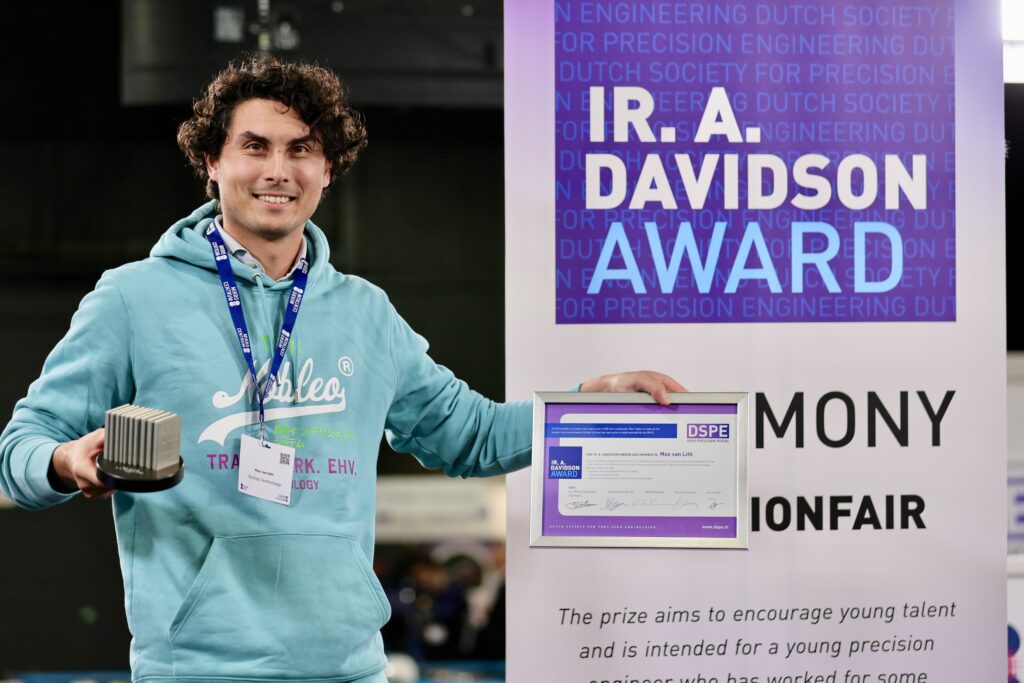
During the 22nd edition of the Precision Fair, held in Den Bosch (NL), the Ir. A. Davidson Award 2023 was presented to Max van Lith, mechatronics engineer at Nobleo Technology in Eindhoven (NL). He received the prize for his role as a lead mechanical engineer who sets out the guidelines for mechanical and system designs in a systematic and analytical manner. “Max is truly an emerging talent, a knowledge provider and source of information for his colleagues. Even with limited information and requirements, Max always manages to get possible design directions down on paper.”
The DSPE board presented the Ir. A. Davidson Award to Max van Lith on the afternoon of Wednesday, 15 November. The purpose of the prize is to encourage young talent by recognising the efforts of a precision engineer who has been working for several years at a company or institute, and has a proven performance record that has been acknowledged both internally and externally. The candidates must also demonstrate an enthusiasm for their field that results in a positive effect on their colleagues. The biennial prize, established in 2005 and now presented for the ninth time, is named after an authority in the field of precision mechanics who worked at Philips in the 1950s and 1960s. The prize comes with a certificate, a trophy and a sum of money sponsored by DSPE. The trophy is created by the Leidse instrumentmakers School and is designed in the form of Davidson’s handbook series on precision mechanics that he used as a foundation when forming the constructors’ community at Philips.
Award-winning graduation work
This year, the jury received fifteen nominations for the Ir. A. Davidson Award. The choice ultimately fell on Max van Lith, who studied Mechanical Engineering at Eindhoven University of Technology (TU/e). He did his graduation work at VDL ETG, for which received a nomination for the Wim van der Hoek Award in 2017. His work involved the design of a Z mechanism for wafer handling that had to function 24/7 in a vacuum environment. Contamination and wear, therefore, had to be prevented as much as possible. He solved this in his design by opting for elastic spring elements and contactless voice-coil actuation. All this, of course, statically determined, as he described in DSPE’s magazine Mikroniek.
Proper lead mechanical engineer
Max van Lith subsequently developed into a proper lead mechanical engineer at his employer Nobleo Technology in Eindhoven. According to the jury, “He sets out the guidelines for mechanical and system designs in a systematic and analytical manner. He has had a hand in various designs for the semiconductor industry, among others, from complex linear guides with elastic elements to optomechatronic designs. This is to the great satisfaction of customers, who consider his efforts and involvement remarkable. Even with limited information and requirements, Max always manages to get possible design directions down on paper.”
Sharing knowledge
Furthermore, Max van Lith is committed to taking professional competencies to a higher level within Nobleo Technology. The jury further explained its decision by saying, “For example, he is available as a source of information for the design of glued constructions, he is known as a knowledge provider in the field of porous air bearings, and he provides training in carrying out tolerance analyses. Guiding TU/e graduates is also one of his activities, where he contributes to the publication of their work, such as in Mikroniek. Max also shares his knowledge and enthusiasm outside his own organisation. For example, he presents his acquired skills in designing with magnetism in a guest lecture at TU/e in the Mechatronic Design course, part of the Bachelor’s degree in Mechanical Engineering.”
“Real up-and-coming talent”
“The above findings have convinced us that Max van Lith is a deserving winner of the Ir. A. Davidson Award 2023,” said jury chairman Willem Tielemans. “Max is a real up-and-coming talent. With this award, we want to motivate him to continue developing in the field and spread his enthusiasm even more.”
Kees Verbaan (NTS) wins Ir. A. Davidson Award 2021
Prize for multidisciplinary, enthusiastic system architect
The DSPE board presented the Ir. A. Davidson Award to Kees Verbaan on the afternoon of Wednesday 10 November. The purpose of the prize is to encourage young talent by recognising the efforts of a precision engineer who has been working for several years at a company or institute and has a proven performance record that has been acknowledged both internally and externally. Candidates must have also demonstrated an enthusiasm for the field that results in a positive effect on young colleagues. The biennial prize, which was established in 2005 and was now presented for the eighth time, is named after an authority in the field of precision mechanics who worked at Philips in the 1950s and 1960s. The prize comes with a certificate, a trophy and a sum of money sponsored by DSPE. The trophy was created by the Leidse instrumentmakers School in the form of the handbook on precision mechanics that Davidson used as a foundation when forming the constructors community at Philips.
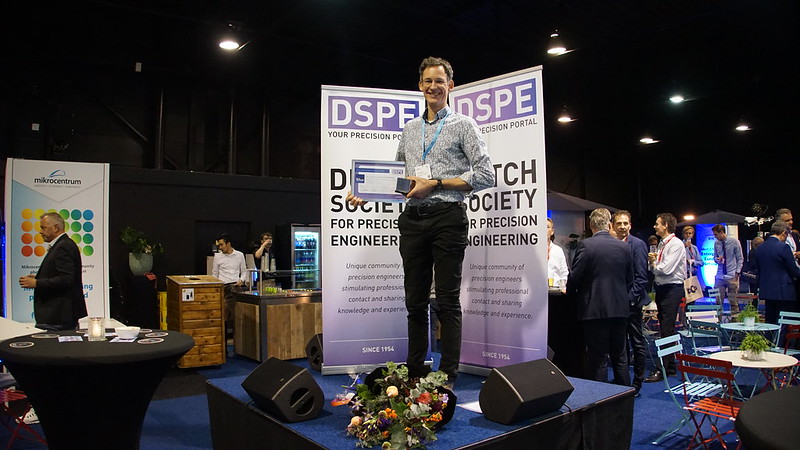
Kees Verbaan proudly showing the certificate and trophy that come with the Ir. A. Davidson Award 2021. (Foto Susanne van Doornik Mikrocentrum)
Critical contributions
Once again, the jury received a large number of nominations for the Ir. A. Davidson Award; this year even ten. The jury’s choice ultimately fell on Kees Verbaan. Verbaan studied Mechanical Engineering at HU University of Applied Sciences Utrecht and Eindhoven University of Technology, where he subsequently obtained his Ph.D. degree in 2015 with Prof. Maarten Steinbuch for research into the role of damping in the control of precision systems. He then started working as a system architect at first-tier system supplier NTS in Eindhoven. In this position, he focuses on design challenges related to accurate positioning in complex machines. In doing so, he uses his extensive knowledge of design principles and in particular passive damping, the subject of his Ph.D. research. Also, in a leading role, he made crucial contributions to challenging projects that are very important to NTS.
Enthusiastic and constructively critical
According to the jury, as a system architect Verbaan can easily balance the required depth in the technology, and the cost price target and other preconditions from the customer. Due to his enthusiastic and constructively critical attitude, he always manages to get the project team on board. He is also not afraid to get his hands dirty – proverbially – by helping with assembly in the cleanroom if necessary or by providing pizza if the team has to work long hours. In addition, he is involved in knowledge sharing and competence building inside and outside NTS. He always makes time for coaching colleagues and students, and contributes to meetings of DSPE and international associations. In his specialist field, passive damping, he contributes as a teacher to two courses of the High Tech Institute via Mechatronics Academy.
“True professional”
All in all, Kees Verbaan can move easily through a wide range of disciplines and activities, both theoretically and practically. He does this with his characteristic helpfulness and enthusiasm, according to jury chairman Willem Tielemans. “He is interested in the direction in which his profession is developing and helps his employer to respond to this. In this way, he knows how to direct and connect others in order to jointly drive developments. All this makes him a true professional in his role, an asset to the field of precision technology and a deserved winner of the Ir. A. Davidson Award 2021.”
Lennino Cacace (AC Optomechanix) wins Ir. A. Davidson Award 2018
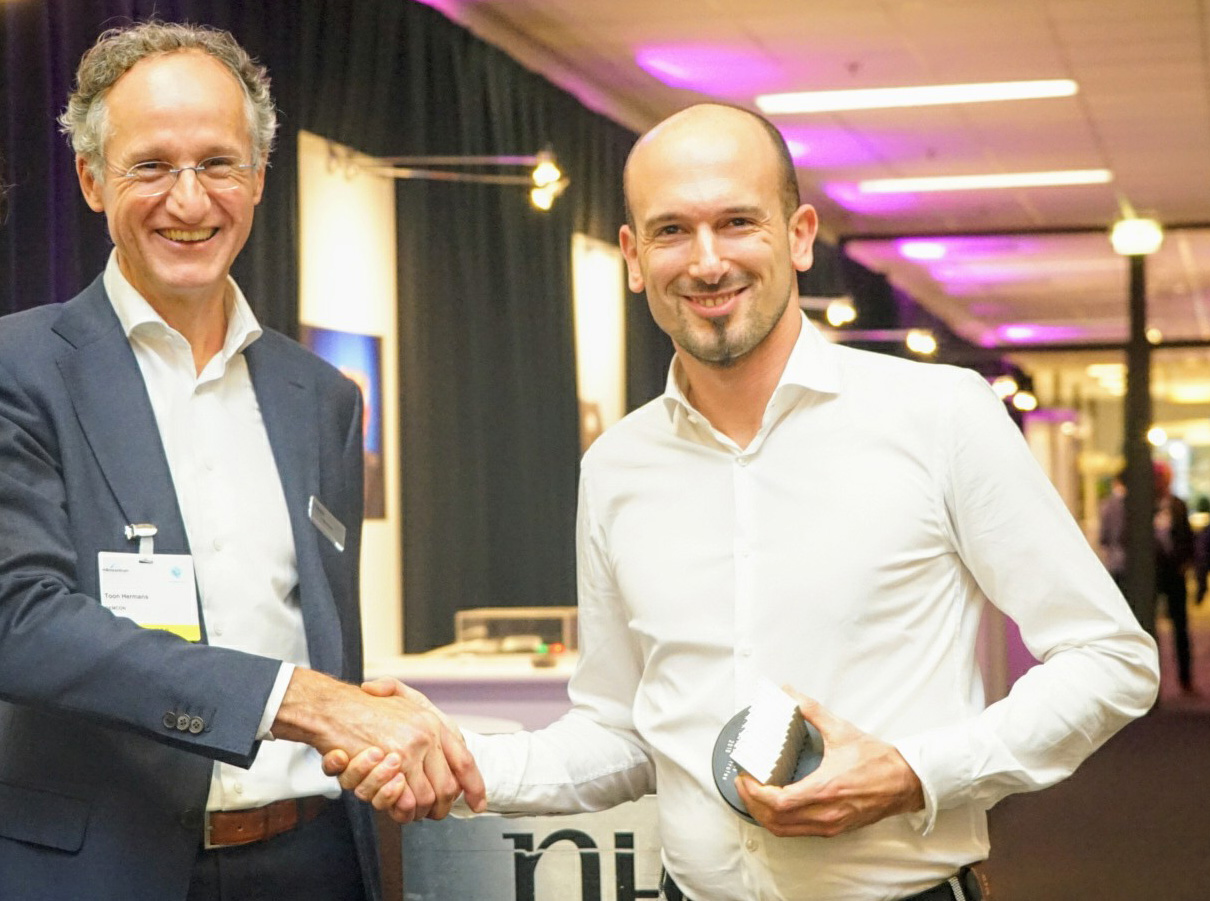
During the 18th edition of the Precision Fair in Veldhoven, the Netherlands, the Ir. A. Davidson Award was presented, under the auspices of DSPE, to Lennino Cacace. Cacace is the owner of AC Optomechanix, an engineering firm for optomechanics and precision engineering. He received the prize for his outstanding designs of complex optical systems and sensors, and his contribution to education in optomechatronics.
DSPE board member Toon Hermans, the managing director of Demcon South, presented the Ir. A. Davidson Award on the afternoon of Wednesday 10 November. The purpose of the prize is to encourage young talent by recognising the efforts of a precision engineer with several years of experience working at a company or institute and a proven performance record which has been acknowledged internally and externally. Candidates must also have a demonstrated enthusiasm for the field that produces a positive effect on young colleagues. The biennial prize, which was established in 2005, is named after an authority in the field of precision mechanics who worked at Philips in the 1950s and 1960s. The prize comes with a certificate, trophy and sum of money. The trophy was created by the Leiden Instrument Makers School (LiS) in the form of the handbook in precision mechanics that Davidson used as a foundation when forming the constructors community at Philips.
Complex optics
This year, the panel of judges for the Ir. A. Davidson Award received a large number of nominations of excellent candidates, from which they unanimously selected Lennino Cacace as the winner. He studied Mechanical Engineering at Eindhoven University of Technology (TU/e) and graduated cum laude. In 2009, he obtained his Ph.D. degree from Maarten Steinbuch, a TU/e professor of control engineering, for the design of a measuring head for the advanced measuring machine Nanomefos, developed by TNO for freeform metrology. In 2006, he had already established his own company, AC Optomechanix, an engineering firm specialising in optomechanics and precision engineering. He has developed various complex sensors and has worked for, among others, the lithography machine builders ASML and Liteq. At the latter company, now part of Kulicke & Soffa, he fulfilled the role of optical-mechatronic system engineer for Liteq’s waferstepper for packaging chips. He also was responsible for a large part of the optical design, including the mechatronic design of the optical column of the machine.
Education in optomechatronics
As of the last year and a half, Cacace has been involved in the new Master of Optomechatronics that was set up at TU Delft. In his own lecture on optomechatronics, he gives a good overview of the system aspects and the constructive, optical and even electronic aspects of designing an optical system. In future, this course will also be given in Eindhoven, in a form that is tailored to the industry.
“There are few mechanical engineers who have already studied optics so well during their studies. At the same time, Lennino is a good designer. What is also special is that he has a clear vision of the profession and has succeeded in incorporating this into the optomechatronics master and lecture.” So said the panel of judges, who characterise Lennino Cacace as an inquisitive, helpful and very honest natural designer and a perfectionist. “He is highly skilled in theory and in practice and experimentation and is keen to pass on his knowledge.”
Hall of Fame
| 2023 | Max van Lith | Nobleo Technology |
| 2021 | Kees Verbaan | NTS |
| 2018 | Lennino Cacace | AC Optomechanix |
| 2016 | Wouter Aangenent | ASML |
| 2014 | Rens Henselmans | NTS Group |
| 2011 | Edwin Bos | Xpress Precision Engineering |
| 2009 | Krijn Bustraan | Philips Apptech |
| 2007 | Martijn Leenders | ASML |
| 2005 | Henk-Jan van der Pol | Demcon |
References


Prize for new design principle for passive damping. During the 24th edition of the Precision Fair in Den Bosch (NL), the Wim van der Hoek Award was presented under the auspices of DSPE (Dutch Society for Precision Engineering).
Read more
Prize for system designer, inventor, connector and inspiring mentor
Read more